

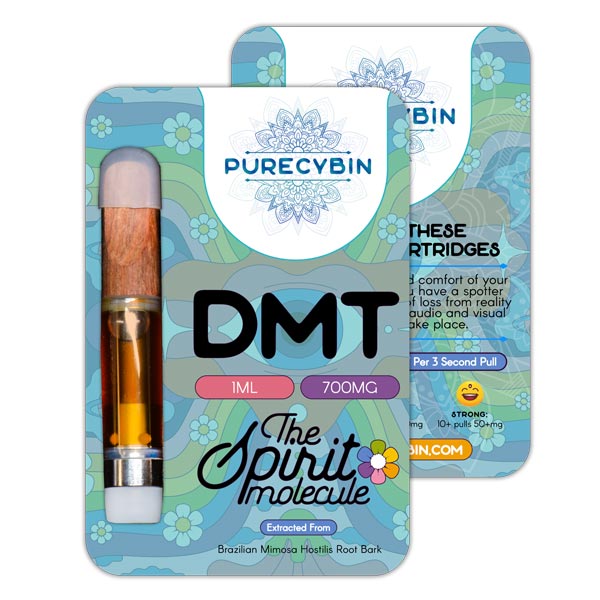
Purecybin DMT Cart – 1mL | 700mg DMT
$235.00
The Spirit Molecule
extracted from Brazilian Mimosa Hostilis root bark
1ml
700MG DMT
Fits easy with 510 thread cartridges
Description
Description
How Much Is a DMT Cart? Real Pricing, Value Breakdown, and What Drives Cost
Introduction
“How much is a DMT cart?” is one of the most searched questions in this space — and the answer isn’t a single number. DMT cart pricing in 2026 spans a range wide enough to be genuinely confusing: legitimate documented products start around $100 and top out around $350 for premium high-concentration fills, while counterfeit and underdosed products flood the lower end of that same range. The price you pay doesn’t automatically reflect the product you receive. This guide breaks down every cost variable — formulation type, concentration, fill volume, brand tier, hardware inclusions — and gives you a real, specific understanding of what a DMT cart should cost and why.
The Short Answer: DMT Cart Price Range in 2026
Before the detailed breakdown, here’s the straightforward pricing landscape by product type:
The grey-market street price range for DMT carts broadly runs $100–$400 per cartridge — but that upper boundary largely reflects premium high-concentration products and kit bundles, not standard single-cart pricing.
What Determines How Much a DMT Cart Costs
Six variables drive pricing across the market. Understanding each one lets you evaluate whether any specific listing represents fair value or a red flag.
1. Formulation Type (N,N-DMT vs. 5-MeO-DMT)
5-MeO-DMT carts consistently price $15–$30 higher than comparable N,N-DMT fills at equivalent volume. This reflects the compound’s greater difficulty to source and synthesize at pharmaceutical purity levels. At a 0.5mL comparison point, an N,N-DMT cart runs $100–$135 while a 5-MeO-DMT cart of the same volume runs $120–$160.
The price premium is partly offset by the lower effective dose per session that 5-MeO-DMT’s superior potency enables — approximately 4–6 times less compound required per breakthrough experience compared to N,N-DMT. On a per-session cost basis, the two formulations are closer in value than their sticker prices suggest.
2. Active Compound Concentration
This is the variable most commonly ignored by first-time buyers and most exploited by low-quality vendors. Concentration drives value, not volume alone.
A 1mL cart at 300mg/mL contains 300mg total DMT. A 1mL cart at 700mg/mL contains 700mg — more than twice the active compound at a fraction more price. Evaluating price without knowing the mg/mL concentration is like evaluating coffee by the cup size without knowing the brew strength. Two differently priced carts at identical volume can represent very different per-mg value.
Market-standard concentrations for legitimate N,N-DMT carts: 300–800mg per mL. For 5-MeO-DMT: 150–300mg per mL.
3. Fill Volume (0.5mL vs. 1mL)
Fill volume is the most visible pricing variable — larger carts cost more. But the per-mg cost often favors the 1mL format:
-
Deadhead Chemist 1mL N,N-DMT at $134 vs. 0.5mL + battery kit at $135 — the 1mL cart delivers roughly twice the active compound at nearly the same price
-
Vice City Labs 5-MeO-DMT 1mL at $160 vs. 0.5mL at $120 — the 1mL represents better per-mg value despite the higher sticker price
For buyers who use DMT carts consistently, 1mL purchases represent the most cost-efficient format from a per-session perspective.
4. Brand Documentation Tier
Pricing stratifies clearly across brand documentation levels:
Tier 1 — Fully documented brands (Deadhead Chemist, Purecybin, Vice City Labs, Puff Boyz): $120–$180 for standard fills. These carry COAs, batch numbers, and consistent fill weights. You’re paying for verification infrastructure, not just compound.
Tier 2 — Partially documented brands (Schwifty Labs, Shroom Bros, Delila): $100–$160. COA may be available on request rather than proactively provided. Product quality is generally consistent but verification requires more active engagement from the buyer.
Tier 3 — Anonymous or undocumented listings: $40–$100. No COA, no stated concentration, no formulation specificity. The price reflects the absence of quality infrastructure — and so does the product quality.
5. Hardware Inclusions
Cart-only vs. kit-with-battery pricing:
-
Cart only: baseline price for the formulation and volume
-
Cart + compatible battery: adds $15–$20 to cart-only pricing
-
Disposable pen format (cart and battery integrated, non-refillable): typically prices similarly to or slightly above cart-only, at $120–$165
The battery inclusion adds cost but genuine value for first-time buyers who don’t own a compatible variable-voltage 510 battery. For buyers who already own compatible hardware, cart-only is straightforward savings.
6. Sourcing Channel
Where a cart is purchased affects price:
-
Canadian grey-market dispensaries: Tend toward higher pricing ($130–$180+) with more documentation
-
U.S. grey-market online platforms: Wider range ($100–$250), quality variance broader
-
In-person networks: Pricing often below documented market rates; verification is physical rather than documentary
-
Anonymous channels (Telegram, social media DMs): Pricing artificially low ($40–$80) to attract buyers who then receive counterfeits or substitutes
Per-Session Cost: The More Useful Number
The sticker price tells you what you’re paying upfront. The per-session cost tells you what the cart is actually worth relative to the experience it delivers.
For a 0.5mL N,N-DMT cart at 400mg total DMT, at correct voltage and proper inhalation technique:
-
Threshold session (1 short pull, ~1–2mg absorbed): approximately 200–250 sessions → $0.48–$0.60 per session
-
Moderate session (2 pulls, ~5mg absorbed): approximately 60–80 sessions → $1.50–$2.00 per session
-
Breakthrough session (3 full pulls, ~10–15mg absorbed): approximately 25–35 sessions → $3.40–$5.00 per session
Compared against other psychedelic formats at equivalent intensity:
On a per-session cost basis, a properly priced DMT cart at the breakthrough level is 3–7 times cheaper per session than equivalent-intensity alternative psychedelic formats — despite the higher sticker price. The math strongly favors cart purchases over smaller-quantity alternatives once usage is consistent.
Price Red Flags: When a DMT Cart Is Priced Wrong
Both ends of the pricing spectrum signal problems. Here’s what each direction means:
Prices That Are Too Low
Below $80 for a 0.5mL cart is the floor below which product legitimacy becomes statistically improbable. Legitimate production of a documented DMT cart — quality compound, PG/VG carrier, ceramic coil hardware, glass chamber, labeling, and even minimal packaging — cannot be produced profitably below this threshold.
What’s in carts priced at $40–$75:
-
Flavored PG/VG solution with trace or zero active compound — produces no effect regardless of voltage or inhalation technique
-
Research chemical substitutes — unknown compounds that may produce dangerous effects at DMT-calibrated doses
-
Heavily underdosed product — contains some DMT but at a fraction of stated concentration
-
Counterfeit brand packaging around any of the above
Customers frequently report spending $55–$70 on “bargain” DMT carts that produce zero effect across multiple sessions at various voltages — effectively a complete financial loss. The per-session cost of a cheap counterfeit cart approaches infinity when sessions produce no effect.
Prices That Are Too High Without Documentation
A $300 single-cart listing with no COA, no stated concentration, and no verifiable vendor history is not a premium product — it’s a documentation vacuum with premium pricing. In the legitimate documented market, single-cart prices above $180 are reserved for high-concentration 1mL fills from documented brands. Anything above that threshold without documentation is a price anchor designed to imply quality that isn’t there.
Inconsistent Pricing for Named Brands
Established brand pricing is relatively consistent across legitimate platforms:
-
Deadhead Chemist 1mL N,N-DMT: $134–$160 across documented platforms
-
Puff Boyz 0.5mL 400mg: $120–$135
-
Vice City Labs 5-MeO-DMT 1mL: $160–$180
A “Deadhead Chemist” cart listed at $65 or a “Puff Boyz” cart at $50 is almost certainly a counterfeit using the brand’s recognition to convert a low-quality product into a more trusted-seeming transaction. Price deviation of more than 20% below a brand’s standard market rate is a counterfeiting signal.
How to Evaluate Value at Any Price Point
Five questions to ask before committing to any DMT cart purchase based on price:
-
Is the concentration in mg/mL stated? Without this, price comparison is meaningless — you don’t know what you’re getting per dollar
-
Is a COA available? If not, the price reflects an unverified claim. No documentation means no quality assurance regardless of price point
-
Does the price align with the brand’s standard market rate? Significant undercutting of established brand pricing is a counterfeiting signal, not savings
-
What does the per-session math look like? Divide the price by your expected number of sessions at your typical dose level — this is the number that actually reflects value
-
What’s included? Cart only, cart plus battery, or disposable — these are different products at different price points and shouldn’t be compared directly
Pros and Cons of Paying More for a Documented DMT Cart
Pros of paying $120–$180 for a documented product:
-
Verified concentration means predictable per-session dosing — you know what each pull delivers
-
COA confirms compound identity and absence of adulterants — the baseline safety standard in an unregulated market
-
Ceramic coil hardware and glass construction standard at this price tier
-
Batch traceability allows cross-referencing the physical product to its lab results
-
Brand accountability — established vendors with reputational stakes maintain more consistent fill weights and formulations
Cons:
-
Higher upfront cost versus undocumented alternatives
-
Price premium doesn’t guarantee zero quality variance — even documented brands have had batch inconsistencies
-
Legal risk doesn’t scale with price — a $180 documented cart carries identical federal legal exposure as a $50 counterfeit
-
Limited consumer protection in grey-market transactions regardless of price paid
DMT Cart Pricing by Region
Price consistency varies meaningfully by geographic market:
United States: The broadest range — $40 (counterfeit/underdosed) to $250+ (documented premium). The lack of regulatory framework means pricing reflects vendor discretion entirely. Buyer verification burden is highest.
Canada: Prices tend toward the $130–$200 range from Canadian-based grey-market dispensaries. The market is more structured than U.S. grey-market alternatives, with documented brands more consistently represented. Pricing premium over U.S. sources reflects more reliable documentation infrastructure.
International (UK, Australia, EU): Prices vary by sourcing channel. International shipping from Canadian or U.S. grey-market vendors adds $15–$40 in logistics costs to cart pricing, plus import and customs risk. In-country sourcing through local networks tends to price similarly to U.S. grey-market rates but with even less documentation consistency.
Common Misconceptions About DMT Cart Pricing
“The most expensive option is the best quality.” Premium pricing is necessary but not sufficient for quality. A $250 cart from an undocumented vendor is not inherently better than a $135 cart from Puff Boyz with a verifiable COA. Price is a floor indicator — it tells you when something is definitely wrong (below $80) but doesn’t guarantee quality above that floor. Documentation is the quality variable that pricing cannot substitute for.
“I can get the same product cheaper by looking harder.” In legitimate markets, price competition does compress margins over time. In the grey market for DMT carts, price compression below the $100 floor represents product quality degradation — not competitive efficiency. The compound cost, hardware cost, and preparation overhead for a legitimate DMT cart don’t meaningfully reduce below established market rates.
“Bulk packs are always better value.” Six-cart bulk packs at $180–$335 represent genuine per-unit savings when the vendor is documented and the COA covers the full batch. Buying six undocumented carts at a lower per-unit cost doesn’t distribute risk — it multiplies it. Bulk purchasing is only a value decision when applied to verified product from a consistent source.
FAQ
How much does a DMT cart cost on average?
The average price for a legitimate, documented N,N-DMT cart is $120–$160 for a standard 0.5mL fill and $134–$160 for a 1mL fill. 5-MeO-DMT carts run slightly higher at $120–$180depending on volume and concentration. Cart-plus-battery kits add approximately $15–$20 to cart-only pricing.
Why are some DMT carts as cheap as $40–$60?
Products in this price range almost universally indicate underdosed, counterfeit, or substituted content. Legitimate DMT cart production — quality compound, ceramic coil hardware, and even basic packaging — cannot be delivered profitably below $80–$100. Prices below this floor are a hard red flag for product quality regardless of how convincing the packaging appears.
Is $120 a fair price for a DMT cart?
Yes — $120 represents the lower end of the legitimate documented market. At $120, you should receive a 0.5mL N,N-DMT cart at 300–400mg from an established brand with accessible COA documentation. This is fair value when the vendor, documentation, and brand are all verified.
How much does a 5-MeO-DMT cart cost compared to N,N-DMT?
5-MeO-DMT carts consistently price $15–$30 higher than comparable N,N-DMT fills. The potency differential (5-MeO-DMT is 4–6x more potent per mg) partially offsets this on a per-session cost basis — fewer pulls are required per session with 5-MeO-DMT.
How much should a DMT cart and battery kit cost?
Kit bundles from documented brands run $135–$180 depending on formulation type and fill volume. Specifically: Deadhead Chemist 0.5mL N,N-DMT kit at $135, Vice City Labs 5-MeO-DMT 0.5mL kit at $140, and Vice City Labs 5-MeO-DMT 1mL kit at $180.
What is the most cost-efficient way to buy DMT carts?
The 1mL format from documented brands offers the best per-mg value — roughly twice the active compound at a marginally higher sticker price than 0.5mL equivalents. Bulk packs (6-cart assortments at $180–$335) offer additional per-unit savings but only represent genuine value when purchased from a vendor with batch-level COA documentation.
How much does raw DMT cost compared to a cart?
Raw DMT powder prices $100–$300 per gram at street level. A 1mL cart at 700mg contains 0.7 grams of active compound embedded in carrier fluid — meaning the cart price ($134–$160) is competitive with raw powder pricing when you account for the carrier preparation, hardware, and packaging overhead. For users who would need to purchase separate vaporization equipment and prepare their own solution, the pre-filled cart often represents comparable or lower total cost.
Does the DMT cart price vary by country?
Yes — pricing varies by regional sourcing channel. Canadian-sourced documented products tend to price at $130–$200 with better documentation consistency. U.S. grey-market sources span $40–$250+ with wider quality variance. International buyers face additional logistics costs of $15–$40 when sourcing from North American vendors.
Closing Thoughts
How much a DMT cart costs is ultimately less important than what that cost delivers. At the $120–$160 price point from a documented vendor with a COA and explicit formulation labeling, you’re making one of the most cost-efficient investments available in the psychedelic space — a verified product delivering 25–35 full breakthrough sessions at $3–$5 per experience. Below $80, the probability of receiving that value collapses almost entirely. Above $180 without documentation, you’re paying a premium that no label claim can justify.
The question isn’t just “how much is a DMT cart” — it’s how much is a verified one, from a documented vendor, at the right concentration for your intended use. That answer sits consistently between $120 and $180 for most buyers in 2026.
For current pricing on verified products with stated concentrations and accessible lab documentation, covers up-to-date listings across all major documented brands.
Delivery Info
- Standard and Express delivery services are available for all items.
- Shipping costs are calculated at the checkout page (after delivery option & destination confirmation).
- Tracking is available for all delivery options.
- Items are delivered during standard business hours.


Reviews
There are no reviews yet.